

Ai in higher education

AI in Higher Education: Are Institutions Ready to Make It Useful?

AI in Higher Education: Are Institutions Ready to Make It Useful?

PUBLISHED ON OCT 15, 2026

BY SHASHANK CHOUHAN

AI in higher education is no longer a future-facing question. Students are using AI to learn, faculty are experimenting with it in teaching, and institutions are developing policies to guide its use. But adoption by itself does not tell us whether AI is improving learning or whether institutions are prepared to help students and educators use it well.

The Digital Education Council’s AI in Higher Education Global Survey 2026 brings together 45,398 responses, 27,284 from students and 18,114 from faculty across 35 countries. Its findings point to a practical leadership question: how can institutions move from scattered AI use to learning experiences, assessments and policies that are useful, understandable and reviewable?

AI adoption in higher education is widespread, but learning value is not settled.

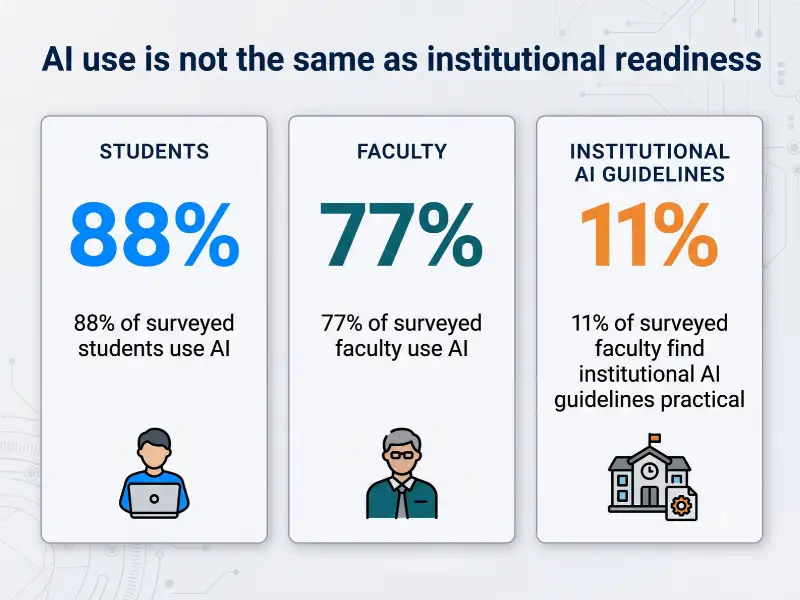
The report says 88% of students use AI in their learning and 77% of faculty use AI in their teaching.

Yet the experiences students report are mixed. Among students who said they had used or were using AI in their learning (n=8,422), 61% said they spend less time on repetitive tasks and focus more on thinking through ideas. In that same respondent base, 21% said they find it harder to work through problems without AI, and 19% said they retain less because they rely on AI.

The report’s executive summary rounds or reports the difficulty figure as 22%, so this article uses the detailed chart’s 21% figure and its stated base.

Those findings should not be reduced to a simple verdict that AI is either helping or harming students. They point instead to a need for intentional use:

What is AI helping a student do, what knowledge or skill is the student expected to develop, and how will educators know whether learning is taking place?

For institutions, this means looking beyond tool access. Course design, assessment, faculty support and student guidance all shape how AI is used. An institution may have high adoption and still need better ways to understand whether that adoption is supporting its academic goals.
AI integration across university courses remains uneven.

In the detailed chart, 15% of students said AI was integrated across many courses, 42% said it was integrated in a few, and 43% said they had not experienced AI integration in their courses.

Among students who had experienced AI integration in courses (n=6,190), 5% said it was transformational, 28% said it enhanced understanding and learning outcomes, 42% said it was somewhat helpful, and 24% said it felt mostly novel with limited learning benefit.

This points to a gap between individual experimentation and institution-wide practice. A student may encounter different expectations in every course: one instructor may encourage AI use, another may restrict it, and a third may not explain what is permitted. Faculty may also be working with different levels of training, confidence and support.

A useful institutional response starts with clarity. Where is AI use appropriate? What should students disclose? Which skills should be demonstrated without AI assistance, and which tasks should reflect the way work is changing? These questions belong in course and programme conversations, not only in a central policy document.

AI in university assessment: reflect the skills students will use.

The DEC report says 72% of students do not see this alignment consistently across their assessments: 35% said only some assessments reflect future workplace needs, while 37% said none or only a few do.

That does not mean every assessment should be redesigned around AI. It does mean institutions may need to examine what their assessments are intended to measure. If a programme aims to develop analysis, communication, problem-solving or professional judgement, assessment design should make those expectations visible and give students appropriate opportunities to practise them.

This is a curriculum- and academic-governance-question as much as a technology question. Course outcomes, teaching activity, assessment evidence and improvement decisions need to connect. When those elements are disconnected, it becomes harder for faculty and leaders to see whether a change in teaching or technology is producing the intended educational result.

Institutional AI guidelines must be usable in practice.

The survey highlights a further gap between policy and day-to-day experience. Among 3,862 faculty respondents whose institutions were described as proactive, responsive or cautious (rather than absent), 37% agreed that their institution’s AI guidelines were practical and easy to apply, 39% were neutral and 25% disagreed. The report’s 64% “do not agree” figure combines the neutral and disagree responses; its 11% figure refers to faculty who strongly agreed that the guidelines were practical.

On faculty participation, among 11,181 respondents whose institutions were described as proactive, responsive or cautious, 31% agreed that faculty were meaningfully involved in shaping AI policies; 35% were neutral.

Guidelines are more likely to be useful when the people expected to apply them help shape them. Faculty need examples tied to actual assignments and teaching contexts. Students need to understand expectations before submitting work. Academic leaders need a way to review how guidance is being implemented and where further support is needed.

Policy should not be treated as a one-time publication. It needs to be communicated, applied, revisited and improved as teaching practice and technology change.

Five questions higher-education leaders can ask

Institutions do not need to answer every question at once. These can help leaders begin a focused review:

  1. Where is AI being used in teaching and learning today? Identify formal course use as well as informal student and faculty practice.
  2. What learning outcomes should that use support? Connect technology choices to the knowledge, skills and judgement programmes intend students to develop.
  3. Do assessments make expectations clear? Explain when AI is permitted, how it may be used and what students must demonstrate themselves.
  4. Can faculty and students apply institutional guidance? Test policies against real course scenarios, and invite feedback from the people who use them.
  5. How will the institution review and improve its approach? Establish ownership, evidence, review points and a process for acting on what is learned.

The purpose of these questions is not to create another compliance exercise. It is to make institutional decisions more connected: from course design and assessment to outcome review and improvement.

From isolated tools to connected institutional workflows

AI readiness is not the same as buying an AI product. Institutions also need sound data practices, clear academic ownership, workable policies and processes for reviewing outcomes. Technology can support those processes, but it cannot substitute for faculty judgement, institutional governance or student engagement. For a classroom-level discussion of teacher-AI collaboration and learning tools, see Kramah’s article on AI-powered tools for higher-education learning experiences.

That is why the connections between systems matter. Learning activity, examination results, course and programme outcomes, and quality-review evidence are often managed by different teams or platforms. Where systems can be appropriately connected, institutions may find it easier to follow information from the activity that generated it to the review or improvement decision that uses it.

Kramah’s higher-education digital transformation suite includes products for learning management, examinations, outcome-based education, ERP and accreditation management: Ki-LMS, Ki-EMS, Ki-OBE, Ki-ERP and Ki-AMS.

Institutional challengeRelevant Kramah product
Organising course delivery and assessment activityKi-LMS
Connecting assessments to defined outcomesKi-OBE
Coordinating examination operationsKi-EMS
Maintaining operational institutional dataKi-ERP
Reviewing evidence and improvement processesKi-AMS and framework-specific products

These product pages describe different parts of institutional operations; the systems and workflows an institution can connect depend on its requirements, configuration and implementation.

For example, a university reviewing assessment practice may want to understand how course activity relates to defined outcomes, how examination evidence is handled and how academic teams review performance over time. Connected systems may help organise that work when the institution has agreed on data definitions, responsibilities and review processes. The academic decisions themselves remain with the institution.

AI readiness in higher education is an ongoing institutional practice.

The survey’s findings do not point to a single software fix. They point to work institutions can undertake: make AI expectations clearer, involve faculty and students, review assessment design, connect practice to learning outcomes and establish ways to learn from implementation.

For higher-education leaders, the useful question is not simply, “Where can we add AI?” It is: “What do we want students to learn, how will we know, and can our people and systems support that work?”

Want to map how your institution’s learning, examination and outcome-data workflows fit together? Kramah can help you explore the relevant parts of its higher-education software suite in a tailored institutional walkthrough. Request a demo.


⇒ Source: Digital Education Council’s AI in Higher Education Global Survey 2026

Frequently Asked Questions

What does the DEC AI in Higher Education Global Survey 2026 cover?

The Digital Education Council describes the report as a global study of AI in higher education, covering student and faculty AI use, institutional policy and areas where higher education may need to respond. It reports 45,398 responses across 35 countries, including 27,284 students and 18,114 faculty.

Does high AI adoption mean students are learning more?

Not by itself. The report includes both positive and concerning student responses. Adoption measures use; it does not, on its own, establish learning gains or their cause.

What can universities do to prepare for AI in higher education?

They can clarify expectations, involve faculty and students in policy development, review whether assessments reflect intended learning and professional skills, and establish processes to monitor and improve practice. The right steps will vary by institution and programme.

Can software alone make an institution AI-ready?

No. Software may support learning, examination, outcome and quality workflows, but readiness also requires academic leadership, faculty involvement, student guidance, clear governance and ongoing review.


dashboard on laptop screen

What Is NAAC Accreditation Software? Benefits and Guide for Higher Education

What Is Ki-NAAC Accreditation Software? How Is It Beneficial for Your Institution?

UPDATED ON OCT 30, 2026

BY SHASHANK CHOUHAN

Key Takeaways

  • Definition: NAAC accreditation software is a specialized institutional compliance platform designed to collect, validate, and organize academic and administrative data directly aligned with the National Assessment and Accreditation Council (NAAC) criteria.
  • The Binary Accreditation Shift: Following the recommendations of the Dr. K. Radhakrishnan Committee and the introduction of the NAAC Binary Accreditation Framework, institutions must maintain continuous, audit-ready digital evidence rather than relying on last-minute document sprints every five years.
  • Core Impact: Purpose-built software automates Self-Study Report (SSR) and Annual Quality Assurance Report (AQAR) generation, streamlines Data Validation and Verification (DVV), and cuts faculty clerical workload by up to 60%.
  • Operational Advantage: Replacing scattered spreadsheets with a centralized, role-based system eliminates version conflicts, ensures geotagged proof attachment, and gives leadership real-time visibility into criteria-wise readiness.

Introduction

Preparing for NAAC accreditation has traditionally been one of the most gruelling exercises an Indian college or university undertakes. Historically, the process involved months of frantic paperwork, rooms filled with lever-arch files, and faculty members pulled away from teaching to track down student records and seminar receipts.

With the rollout of the NAAC Binary Accreditation Framework, the rules have evolved. Accreditation is no longer a periodic five-year documentation scramble. Today, institutions face a continuous, year-round commitment to data integrity, verifiable evidence, and transparent institutional quality.

This shift presents institutional leaders with an urgent operational challenge: How do you coordinate thousands of compliance metrics across dozens of departments without overwhelming your faculty?

The proven answer is NAAC accreditation software.

In this guide, we explore what NAAC accreditation software is, how it operates under current regulatory standards, the seven primary benefits of automation, and how platforms like Ki-NAAC Software help institutions build lasting quality assurance.

What Is NAAC Accreditation Software?

NAAC accreditation software is an enterprise-grade education management solution built specifically to map, aggregate, verify, and report institutional data against NAAC criteria, metrics, and quality indicators.

Unlike generic cloud storage tools (like Google Drive) or desktop spreadsheets, dedicated NAAC software is structured around the accreditation lifecycle itself. It maps institutional data directly to NAAC’s core criteria:

  1. Curricular Aspects
  2. Teaching, Learning and Evaluation
  3. Research, Innovations, and Extension
  4. Infrastructure and Learning Resources
  5. Student Support and Progression
  6. Governance, Leadership, and Management
  7. Institutional Values and Best Practices
 
 
+———————————————————————————+
| Traditional Manual NAAC Process |
+———————————————————————————+
| Scattered Excel Sheets –> Lost Receipts/Proofs –> Panic Before Peer Visit |
| Clerical Burden on Faculty –> Inconsistent Data –> High DVV Clarification |
+———————————————————————————+
|
v
+———————————————————————————+
| Automated NAAC Accreditation Software Architecture |
+———————————————————————————+
| Role-Based Department Input –> Central Evidence Vault –> Live Gap Analytics |
| Automated Metric Math –> 1-Click SSR/AQAR Export –> Audit-Proof DVV |
+———————————————————————————+


At its operational core, NAAC accreditation software functions as:

  • A centralized evidence repository that stores geotagged photographs, circulars, feedback surveys, and receipts indexed by specific metric codes.
  • An automated report engine that compiles formatted Self-Study Reports (SSR) and Annual Quality Assurance Reports (AQAR) in compliance with NAAC portals.
  • A continuous compliance dashboard that provides the Internal Quality Assurance Cell (IQAC) with real-time analytics on institutional progress.
  • A role-based collaboration workspace allowing department coordinators, deans, and principals to submit, review, and approve metrics with clear accountability.

Why Manual NAAC Preparation Is No Longer Sustainable

To understand the urgent demand for NAAC software, educational leaders must look at the structural pressures created by recent national reforms.

Under the guidance of the Ministry of Education and the Radhakrishnan Committee recommendations, NAAC has transitioned toward binary accreditation (“Accredited” vs. “Not Accredited”) and maturity-based graded levels. The new framework demands higher data accuracy and verifiable digital proof.

Traditional manual workflows fail under these expectations due to six recurring bottlenecks:

  1. Fragmented Data Silos: Information remains trapped across isolated departmental computers, personal inboxes, and outdated USB drives.
  2. Missing Documentary Proof: During the final review, teams discover that vital evidence—such as geotagged event photos or signed attendance rosters—was never archived.
  3. Data Inconsistencies Across Portals: Discrepancies between data submitted to AISHE, NIRF, UGC, and NAAC trigger severe Data Validation and Verification (DVV) discrepancies.
  4. Version Control Chaos: Multiple versions of spreadsheets (Criteria_3_Final_v2.xlsx) circulate across departments, resulting in overwritten numbers and conflicting attainment data.
  5. Zero Historical Memory: When key faculty members or IQAC coordinators leave, institutional memory and accreditation preparation reset to zero.
  6. Exhausted Faculty: Professors spend hundreds of hours on clerical data entry rather than research publications, patent applications, and classroom innovation.

7 Key Benefits of NAAC Accreditation Software

Migrating from manual spreadsheets to dedicated NAAC accreditation software delivers measurable improvements across every tier of campus administration:

1. Frees Faculty for Core Teaching and Research

The most impactful institutional benefit of NAAC software is time reclamation. In manual institutions, senior professors spend countless hours chasing receipts, reformatting spreadsheets, and validating student rosters.

With specialized software, faculty upload proof documents through structured forms only once. Automated workflows route data to department heads and the IQAC instantly. By eliminating repetitive administrative overhead, faculty can refocus on high-impact scholarly activities, student mentoring, and funded research projects.

2. Centralized, Cloud-Based Evidence Management

Accreditation is an evidence-first audit. It is not enough to declare that a seminar occurred; an institution must present the circular, geotagged photographs, participant lists, and feedback summaries.

NAAC software acts as a secure, indexed digital vault. Every piece of documentation is tagged to its exact criterion, key indicator, and metric. When peer review teams or DVV partners request supporting proof, coordinators can retrieve verified documents within seconds. Learn more about organizing institutional records in our NAAC SSR and DVV Evidence Management Guide.

3. Automated SSR and AQAR Report Generation

Compiling an SSR or AQAR manually often takes six to nine months of stressful consolidation. Staff must manually merge dozens of departmental spreadsheets into massive Word documents, format tables, and check numbering.

NAAC accreditation software automates this entire pipeline. Because the software continuously tracks criteria metrics throughout the semester, administrators can export pre-formatted, portal-ready SSR and AQAR documents with a single click. For details on report structures, see our breakdown on What Is NAAC SSR? New Format Explained.

4. Real-Time Compliance Dashboards and Gap Analysis

In a spreadsheet-based workflow, institutional leadership only sees the complete picture right before the submission deadline—often when it is too late to fix metric deficiencies.

Dedicated software provides live IQAC dashboards that track:

  • Percentage completion for every criterion and department
  • Attainment scores against quantitative metrics
  • Critical data and documentation gaps needing immediate attention

This ongoing visibility empowers leadership to make proactive interventions months before formal audits begin.

5. Role-Based Governance and Institutional Accountability

Managing compliance requires strict delegation across diverse campus roles. Dedicated software establishes structured permission hierarchies:

  • Faculty & Staff: Enter primary activity data and upload supporting attachments.
  • Heads of Department (HODs): Review and verify departmental submissions.
  • IQAC Coordinators: Supervise institutional readiness and audit documentation.
  • Principal & Management: Monitor macro-level analytics and approve final submissions.

To ensure accountability across criteria, explore our Criterion-Wise Evidence Ownership Model for IQAC Teams.

6. Continuous, Year-Round Accreditation Readiness

Accreditation should be an ongoing habit of institutional excellence, not a panicked quinquennial event. Dedicated software turns quality assurance into an organic byproduct of routine academic operations.

When term assessments, student mentoring records, and faculty development completions are logged inside the system daily, the institution remains permanently audit-ready. Peer visits and annual AQAR deadlines cease to cause administrative disruption.

7. Superior Data Integrity and DVV Compliance

The Data Validation and Verification (DVV) stage is where manual applications frequently encounter severe setbacks. Inconsistent student enrollment counts, missing employee service records, or mismatched financial numbers cause significant score deductions.

NAAC accreditation software incorporates automated validation algorithms that check for data consistency across all criteria before submission. This pre-audit validation dramatically reduces DVV clarification notices and safeguards institutional standing.

Manual Process vs. NAAC Accreditation Software: Side-by-Side Comparison

The following matrix illustrates how dedicated software fundamentally transforms institutional operations:

Operational DimensionManual & Spreadsheet ProcessDedicated NAAC Accreditation Software
Data StorageFragmented spreadsheets, local PCs, paper bindersCentralized, secure cloud repository
Document RetrievalSearching through email threads and filing cabinetsInstant search indexed by exact NAAC metric code
Task CoordinationManual follow-up calls, messaging, and emailsAutomated task assignment and approval workflows
SSR / AQAR Creation6 to 9 months of manual cutting and pastingAutomated, 1-click generation in official portal formats
MonitoringBlind spots until right before submission deadlinesLive executive dashboards showing criteria-wise progress
Audit TrailsNo record of cell modifications or deleted entriesImmutable, time-stamped change logs for every record
DVV Risk ProfileHigh risk of data mismatches and rejectionBuilt-in validation algorithms preventing discrepancies

Based on implementation data across more than 100 higher education institutions preparing for NAAC accreditation, institutions deploying automated accreditation software reduced their cycle preparation time from nine months to under six weeks, while decreasing DVV clarification queries by over 70%.

Who Benefits from NAAC Software?

A modern accreditation management platform supports every stakeholder across the institutional hierarchy:

  • IQAC Directors and Teams: Eliminates hundreds of hours of manual report formatting and file tracking, allowing the cell to focus on continuous quality enhancement.
  • Faculty Members: Simple, structured upload forms ensure faculty submit activity reports once, leaving their schedules open for core academics.
  • Department Heads (HODs): Real-time oversight into departmental metric contributions, ensuring every department meets its annual targets.
  • Registrars and Administrators: Ensures synchronized institutional datasets across admissions, HR, examinations, and finance.
  • Principals and Chancellors: Complete transparency into institutional readiness, empowering data-driven decisions that elevate college rankings.

7 Essential Criteria for Choosing the Right NAAC Accreditation Software

When assessing accreditation management systems, institutional leadership should verify that the platform includes these seven essential capabilities:

  1. Alignment with Latest Frameworks: Fully mapped to the current NAAC guidelines and the binary accreditation model.
  2. Integrated Master Data Management (MDM): A unified database that prevents contradictory numbers between student, faculty, and financial modules.
  3. Automated DVV Verification Engines: Pre-submission checks that flag missing documents and mathematical errors.
  4. Outcome-Based Education (OBE) Integration: Direct integration with OBE Software to calculate Course Outcome (CO) and Program Outcome (PO) attainments automatically.
  5. Configurable Role-Based Access: Granular permission settings that secure confidential institutional records.
  6. Multi-Year Historical Archiving: Cloud infrastructure that preserves institutional metrics across multiple accreditation cycles.
  7. Responsive Local Support and Training: A dedicated implementation team with deep domain expertise in Indian higher education compliance.

Ki-NAAC Software by Kramah was architected specifically to fulfill these stringent requirements. As an AI-first, modular platform, Ki-NAAC centralizes your institutional data, eliminates administrative fatigue, and converts complex accreditation compliance into an organized, continuous process.

Conclusion: Transform Compliance into Institutional Excellence

As higher education in India becomes increasingly competitive, relying on obsolete spreadsheets is no longer an acceptable risk. The volume of documentation, the need for continuous quality improvement, and the scrutiny of DVV verification make NAAC accreditation software an indispensable institutional asset.

By replacing manual friction with automated workflows, colleges and universities safeguard their accreditation grades, eliminate faculty burnout, and build an enduring culture of academic excellence.

Ready to modernize your institution’s accreditation workflows? Explore how

Frequently Asked Questions

What is NAAC accreditation software?

NAAC accreditation software is a specialized cloud platform built for higher education institutions to manage, document, and report compliance metrics required by the National Assessment and Accreditation Council. It centralizes institutional data, organizes digital evidence, and automates SSR and AQAR report generation.

How does NAAC software assist during the DVV process?

During Data Validation and Verification (DVV), third-party agencies cross-examine submitted data against digital evidence. NAAC software prevents DVV failure by ensuring that all submitted data points are directly linked to geotagged photographs, official circulars, and validated student records, while eliminating mathematical discrepancies across criteria.

Can NAAC accreditation software integrate with existing college ERPs?

Yes. Modern accreditation systems like Kramah Ki-NAAC integrate seamlessly with existing campus ERPs, Student Information Systems (SIS), and examination databases. This connectivity allows student enrollment, faculty qualifications, and examination results to sync automatically without manual re-entry.

Does NAAC software support the new Binary Accreditation Framework?

Yes. Modern accreditation platforms are updated to support the NAAC Binary Accreditation Framework recommended by the Radhakrishnan Committee. The software evaluates institutional performance across binary attributes and maturity levels continuously throughout the academic year.