
NIRF 2025 Ranking Changes: SDG Category & NIRF Negative Marking Explained
Since its launch, the National Institutional Ranking Framework (NIRF) has primarily evaluated Indian higher-education institutions on teaching quality, research output, graduation outcomes, inclusivity, and perception. Over the years, the framework has evolved gradually, refining formulas and data sources while keeping its core structure intact.
NIRF 2025 marks a clear break from this incremental approach. It introduces changes that go beyond metric tuning and instead reshape what institutions are rewarded for. For the first time, rankings explicitly factor in sustainability impact, research integrity, and the on-ground implementation of National Education Policy (NEP) 2020 reforms.
What makes 2025 the most significant methodological shift so far is the combination of new categories, ethical enforcement, and policy alignment. Rather than focusing only on academic volume and reputation, NIRF now signals what kind of higher-education system India wants to promote.
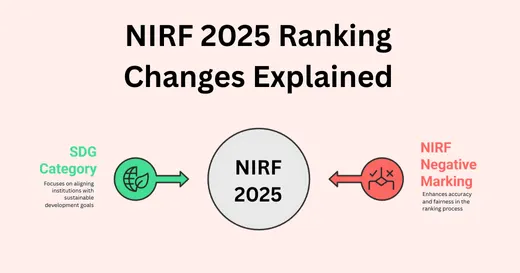
At the heart of NIRF 2025 are four major focus areas:
- A dedicated Sustainable Development Goals (SDG) ranking category
- Expansion of ranking categories to include newer institutional models
- Negative marking for retracted and poor-quality research
- Deeper operational integration of NEP 2020, including IKS, regional languages, and flexible learning
Together, these shifts reposition NIRF as both a ranking mechanism and a governance tool.
What’s New in NIRF 2025 Ranking: Overview of Major Changes
NIRF 2025 introduces changes that affect who is ranked, how scores are calculated, and what institutional behaviour is encouraged.
At a high level, the key changes include:
- Introduction of a new SDG-focused ranking category, expanding the framework beyond academic performance
- Increase in total ranking categories to 17, building on the specialized lists for Open, Skill, and State-Funded Public Universities introduced in the previous cycle
- Implementation of negative marking for retracted research papers and related citations under the Research and Professional Practice (RP) parameter
- Stronger and more explicit integration of NEP 2020 priorities into scoring, especially within Teaching, Learning and Resources (TLR)
- Refinement of internal formulas within RP and TLR while keeping the five core parameters structurally intact
These updates collectively position NIRF 2025 as a policy-aligned ranking framework. The methodology now reflects national priorities around sustainability, ethical research practices, and structural reform in higher education, rather than functioning solely as a comparative academic scoreboard.
Introduction of the Sustainable Development Goals (SDG) Category
One of the most visible and conceptually important NIRF 2025 ranking changes is the introduction of a dedicated Sustainable Development Goals (SDG) category. This marks the first time NIRF formally evaluates institutional performance beyond teaching, research, and outcomes.
Why the NIRF SDG Category Was Introduced
The NIRF SDG category aligns NIRF with a global shift in higher-education rankings toward measuring societal and environmental impact. International frameworks such as sustainability and impact rankings have increasingly emphasised how universities contribute to broader development goals, not just academic excellence.
By introducing an SDG category, NIRF moves beyond traditional output-based metrics and acknowledges the role of higher-education institutions in addressing environmental sustainability, social responsibility, and governance outcomes. Commentaries on NIRF 2025 describe this change as a paradigm shift, signalling that institutional responsibility now extends beyond classrooms and laboratories.
What the new SDG Category Evaluates
The SDG category assesses how institutions embed sustainability across operations, research, and academic design. Based on the 2025 framework, evaluation focuses on:
- Green campus practices, including environmentally responsible infrastructure
- Resource and energy management, reflecting sustainable utilisation
- Sustainability-focused research, aligned with development goals
- Integration of sustainability themes into curriculum and institutional governance
This approach emphasises demonstrable action rather than aspirational statements.
How the SDG Category Changes Institutional Priorities
With the SDG category in place, sustainability becomes a measurable ranking outcome rather than a peripheral initiative. Institutions are encouraged to treat environmental responsibility, governance practices, and sustainability-linked research as core strategic functions.
As a result, NIRF 2025 shifts institutional focus toward long-term impact and accountability, reinforcing the idea that higher-education excellence includes contributions to sustainable development alongside academic achievement.
Expansion to 17 NIRF Ranking Categories
NIRF 2025 broadens the scope of India Rankings by formally expanding the total number of institutional categories to 17. This change ensures that the framework continues to recognise the growing diversity of higher-education models in India.
From 16 to 17 Categories
While the previous cycle (2024) saw a massive structural expansion with the addition of Open Universities, Skill Universities, and State-Funded Public Universities, the 2025 cycle builds on this foundation by adding the Sustainable Development Goals (SDG) category.
This brings the total count to 17, reflecting a steady effort to make rankings more representative of India’s evolving higher-education ecosystem.
Maturation of Specialised Categories
The categories that were introduced recently are Open, Skill, and State-Funded Public Universities have now entered their second year of evaluation.
- Open Universities: Institutions operating primarily through distance and open learning models continue to be assessed within their own category, avoiding unfair comparison with residential universities.
- Skill Universities: Universities focused on vocational education and industry alignment are evaluated on metrics specific to skill development.
- State-Funded Public Universities: This category allows for context-appropriate benchmarking among state-governed institutions, separating them from centrally funded giants.
By stabilizing these categories in 2025, NIRF confirms that these distinct institutional models are now permanent fixtures of the ranking architecture.
Why NIRF Category Expansion Matters
The expansion of categories improves the fairness and usefulness of the rankings.
By enabling comparisons between similar institutional models, NIRF reduces distortion that occurs when fundamentally different institutions compete within the same list. For students, this makes rankings more relevant when choosing institutions aligned with specific learning formats or career goals. For policymakers, it provides clearer benchmarking within comparable groups, supporting more informed planning and evaluation.
NIRF 2025 Negative Marking for Retracted and Poor-Quality Research
Among all changes introduced in NIRF 2025, the most high-profile methodological shift is the introduction of negative marking for retracted research papers. This change directly affects the Research and Professional Practice (RP) parameter and links rankings more closely to research integrity.
NIRF 2025 ranking changes in Research and Professional Practice (RP) Parameter
NIRF 2025 introduces negative scoring within the RP parameter for institutions associated with retracted research publications.
For the first time, the framework explicitly accounts for:
- Retracted papers, and
- Citations originating from those retracted papers
This marks a shift from measuring research output and impact alone to also assessing the quality and integrity of published research.
How NIRF 2025 Negative Marking Is Applied
Negative marking is applied through a defined formula that reduces an institution’s RP score based on:
- The number or percentage of retracted publications over a recent multi-year period
- Citation penalties, where citations linked to retracted papers are discounted
The reduction affects overall research scores, even if publication volume or citation counts appear strong on the surface. In the NIRF 2025 Ranking cycle, the penalties are described as mild, serving as an initial corrective mechanism rather than a severe sanction.
Signals on Research Integrity and Future Enforcement
Officials associated with the NIRF process have clearly indicated that negative marking will become progressively stricter in future ranking cycles. The intent is to discourage research malpractice and reinforce accountability in academic publishing.
The framework also signals potential future consequences for institutions with serious or repeated patterns of retracted or manipulated research. These may include public identification or even temporary exclusion from NIRF rankings for a defined period, directly linking research integrity to ranking eligibility.
NIRF 2025 Ranking changes brings deeper Integration of NEP 2020
While earlier NIRF editions acknowledged the National Education Policy (NEP) 2020 at a conceptual level, the 2025 framework moves toward operational integration. NEP principles are no longer aspirational references but are reflected directly in scoring parameters and sub-metrics.
This shift ensures that institutions implementing NEP reforms are visibly recognised in ranking outcomes.
NEP Alignment in Teaching, Learning and Resources (TLR)
In NIRF 2025, NEP 2020 alignment is embedded mainly within the Teaching, Learning and Resources (TLR) parameter. Instead of introducing a separate NEP score, the framework incorporates NEP-linked elements into existing evaluation structures.
This operationalisation means institutions earn credit for demonstrable changes in curriculum design, delivery models, and learning flexibility that reflect NEP mandates. As a result, TLR scores now capture not only infrastructure and faculty strength but also the degree to which institutions have adopted policy-driven academic reforms.
Continued Emphasis on Indian Knowledge Systems (IKS)
A notable NEP-linked focus in NIRF 2025 is the continued and more rigorous recognition of Indian Knowledge Systems (IKS) within the ranking framework.
Institutions receive credit for incorporating traditional and indigenous knowledge into academic programmes and curricula. This inclusion reflects NEP 2020’s emphasis on valuing India’s intellectual heritage alongside contemporary disciplines, and it signals a broader definition of academic relevance within national rankings.
Regional Languages and Flexible Learning Structures
NIRF 2025 also strengthens recognition for institutions that have implemented language and structural flexibility as outlined in NEP 2020.
This includes:
- Programmes offered in Indian regional languages, expanding access and inclusivity
- Multiple entry–exit pathways, allowing students to pause and resume education without academic penalty
- Academic Bank of Credits–style flexibility, enabling credit accumulation and transfer across programmes
By integrating these elements into scoring, NIRF 2025 rewards institutions that have translated NEP’s flexibility goals into operational academic systems.
Refinements Within Existing NIRF Parameters
Beyond headline changes, NIRF 2025 introduces targeted refinements within existing parameters. These adjustments fine-tune how performance is measured while keeping the overall framework structure stable.
1. Changes Inside the RP Parameter
Within the Research and Professional Practice (RP) parameter, NIRF 2025 updates how publications and citations are calculated and normalised.
Key refinements include:
- Updated normalisation of publication volume and citation impact against faculty strength
- Formal integration of retraction penalties into RP scoring formulas
These changes ensure that research performance reflects both scale and integrity, rather than volume alone.
2. Updates in the TLR Parameter
The Teaching, Learning and Resources (TLR) parameter also sees refinements aligned with policy priorities.
In the 2025 framework, greater emphasis is placed on:
- Effectiveness of digital and online education, rather than mere availability
- Sustainability-linked resource utilisation, aligning campus practices with broader environmental goals
These updates signal a shift from input-based reporting toward outcome-oriented evaluation.
3. Stability of Overall Parameter Weights
Despite multiple refinements, NIRF 2025 retains the five core parameters—TLR, RP, Graduation Outcomes (GO), Outreach and Inclusivity (OI), and Perception (PR).
The headline weight distribution, particularly in the Overall category, remains stable. However, the framework explicitly notes that sub-metrics and data sources are evolving, allowing NIRF to adjust methodologies annually in response to national policy priorities and sectoral developments.
How NIRF 2025 Repositions the Ranking Framework
NIRF 2025 marks a clear shift in how rankings function within India’s higher-education system. Rather than operating solely as a performance comparison tool, the framework increasingly acts as a policy instrument.
Earlier editions focused on measuring academic strength through teaching capacity, research output, and graduate outcomes. In contrast, NIRF 2025 embeds national priorities directly into evaluation criteria, influencing institutional behaviour beyond numerical performance.
This repositioning places strong emphasis on:
- Sustainability, through the introduction of an SDG-focused category
- Ethical research practices, via negative marking for retracted and poor-quality research
- NEP 2020 readiness, reflected in curriculum design, language inclusion, and flexible learning structures
As a result, rankings now signal not just how well institutions perform, but how responsibly and strategically they align with India’s higher-education reforms.
Summary of Key NIRF 2025 Ranking Changes
For institutions and stakeholders seeking a focused view of what has changed, NIRF 2025 introduces five defining updates:
- Introduction of an SDG ranking category, formally integrating sustainability and societal impact into evaluations
- Expansion to 17 ranking categories, consolidating the specialised lists for Open, Skill, and State-Funded Public Universities
- Negative marking for retracted research papers and related citations, strengthening research integrity enforcement
- Deeper integration of NEP 2020, covering Indian Knowledge Systems, regional languages, and multiple entry–exit pathways
- Refinement of RP and TLR metrics, aligning research quality, digital learning effectiveness, and sustainability-linked resource use
Together, these changes represent a structural recalibration rather than isolated methodological tweaks.
Conclusion: What Institutions Should Take Away from NIRF 2025 Ranking Changes
NIRF 2025 ranking changes reflects a broader transformation in how higher-education quality is defined and evaluated in India. Rankings now mirror national policy priorities, not just institutional performance metrics.
The framework sends a clear message: institutions are assessed not only on academic scale and visibility, but also on sustainability practices, research integrity, and the speed of NEP 2020 adoption. These elements are no longer peripheral initiatives but central to ranking outcomes.
For institutions, the takeaway is straightforward. Long-term ranking performance in NIRF will increasingly depend on ethical research systems, policy-aligned academic reforms, and measurable contributions to sustainable development making NIRF 2025 a roadmap as much as a ranking.