
AI in Higher Education: Are Institutions Ready to Make It Useful?
PUBLISHED ON OCT 15, 2026
BY SHASHANK CHOUHAN

AI in higher education is no longer a future-facing question. Students are using AI to learn, faculty are experimenting with it in teaching, and institutions are developing policies to guide its use. But adoption by itself does not tell us whether AI is improving learning or whether institutions are prepared to help students and educators use it well.
The Digital Education Council’s AI in Higher Education Global Survey 2026 brings together 45,398 responses, 27,284 from students and 18,114 from faculty across 35 countries. Its findings point to a practical leadership question: how can institutions move from scattered AI use to learning experiences, assessments and policies that are useful, understandable and reviewable?
AI adoption in higher education is widespread, but learning value is not settled.
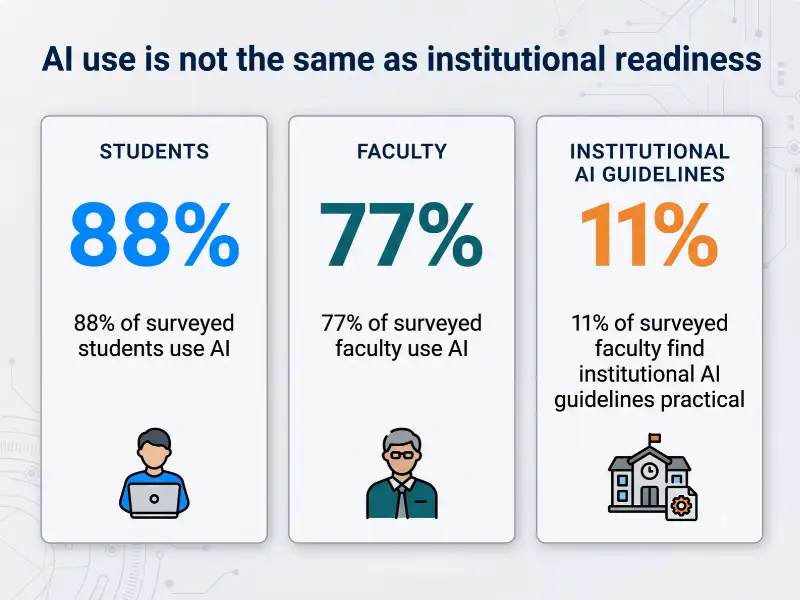
The report says 88% of students use AI in their learning and 77% of faculty use AI in their teaching.
Yet the experiences students report are mixed. Among students who said they had used or were using AI in their learning (n=8,422), 61% said they spend less time on repetitive tasks and focus more on thinking through ideas. In that same respondent base, 21% said they find it harder to work through problems without AI, and 19% said they retain less because they rely on AI.
The report’s executive summary rounds or reports the difficulty figure as 22%, so this article uses the detailed chart’s 21% figure and its stated base.
Those findings should not be reduced to a simple verdict that AI is either helping or harming students. They point instead to a need for intentional use:
What is AI helping a student do, what knowledge or skill is the student expected to develop, and how will educators know whether learning is taking place?
For institutions, this means looking beyond tool access. Course design, assessment, faculty support and student guidance all shape how AI is used. An institution may have high adoption and still need better ways to understand whether that adoption is supporting its academic goals.
AI integration across university courses remains uneven.
In the detailed chart, 15% of students said AI was integrated across many courses, 42% said it was integrated in a few, and 43% said they had not experienced AI integration in their courses.
Among students who had experienced AI integration in courses (n=6,190), 5% said it was transformational, 28% said it enhanced understanding and learning outcomes, 42% said it was somewhat helpful, and 24% said it felt mostly novel with limited learning benefit.
This points to a gap between individual experimentation and institution-wide practice. A student may encounter different expectations in every course: one instructor may encourage AI use, another may restrict it, and a third may not explain what is permitted. Faculty may also be working with different levels of training, confidence and support.
A useful institutional response starts with clarity. Where is AI use appropriate? What should students disclose? Which skills should be demonstrated without AI assistance, and which tasks should reflect the way work is changing? These questions belong in course and programme conversations, not only in a central policy document.
AI in university assessment: reflect the skills students will use.
The DEC report says 72% of students do not see this alignment consistently across their assessments: 35% said only some assessments reflect future workplace needs, while 37% said none or only a few do.
That does not mean every assessment should be redesigned around AI. It does mean institutions may need to examine what their assessments are intended to measure. If a programme aims to develop analysis, communication, problem-solving or professional judgement, assessment design should make those expectations visible and give students appropriate opportunities to practise them.
This is a curriculum- and academic-governance-question as much as a technology question. Course outcomes, teaching activity, assessment evidence and improvement decisions need to connect. When those elements are disconnected, it becomes harder for faculty and leaders to see whether a change in teaching or technology is producing the intended educational result.
Institutional AI guidelines must be usable in practice.
The survey highlights a further gap between policy and day-to-day experience. Among 3,862 faculty respondents whose institutions were described as proactive, responsive or cautious (rather than absent), 37% agreed that their institution’s AI guidelines were practical and easy to apply, 39% were neutral and 25% disagreed. The report’s 64% “do not agree” figure combines the neutral and disagree responses; its 11% figure refers to faculty who strongly agreed that the guidelines were practical.
On faculty participation, among 11,181 respondents whose institutions were described as proactive, responsive or cautious, 31% agreed that faculty were meaningfully involved in shaping AI policies; 35% were neutral.
Guidelines are more likely to be useful when the people expected to apply them help shape them. Faculty need examples tied to actual assignments and teaching contexts. Students need to understand expectations before submitting work. Academic leaders need a way to review how guidance is being implemented and where further support is needed.
Policy should not be treated as a one-time publication. It needs to be communicated, applied, revisited and improved as teaching practice and technology change.
Five questions higher-education leaders can ask
Institutions do not need to answer every question at once. These can help leaders begin a focused review:
- Where is AI being used in teaching and learning today? Identify formal course use as well as informal student and faculty practice.
- What learning outcomes should that use support? Connect technology choices to the knowledge, skills and judgement programmes intend students to develop.
- Do assessments make expectations clear? Explain when AI is permitted, how it may be used and what students must demonstrate themselves.
- Can faculty and students apply institutional guidance? Test policies against real course scenarios, and invite feedback from the people who use them.
- How will the institution review and improve its approach? Establish ownership, evidence, review points and a process for acting on what is learned.
The purpose of these questions is not to create another compliance exercise. It is to make institutional decisions more connected: from course design and assessment to outcome review and improvement.
From isolated tools to connected institutional workflows
AI readiness is not the same as buying an AI product. Institutions also need sound data practices, clear academic ownership, workable policies and processes for reviewing outcomes. Technology can support those processes, but it cannot substitute for faculty judgement, institutional governance or student engagement. For a classroom-level discussion of teacher-AI collaboration and learning tools, see Kramah’s article on AI-powered tools for higher-education learning experiences.
That is why the connections between systems matter. Learning activity, examination results, course and programme outcomes, and quality-review evidence are often managed by different teams or platforms. Where systems can be appropriately connected, institutions may find it easier to follow information from the activity that generated it to the review or improvement decision that uses it.
Kramah’s higher-education digital transformation suite includes products for learning management, examinations, outcome-based education, ERP and accreditation management: Ki-LMS, Ki-EMS, Ki-OBE, Ki-ERP and Ki-AMS.
| Institutional challenge | Relevant Kramah product |
|---|---|
| Organising course delivery and assessment activity | Ki-LMS |
| Connecting assessments to defined outcomes | Ki-OBE |
| Coordinating examination operations | Ki-EMS |
| Maintaining operational institutional data | Ki-ERP |
| Reviewing evidence and improvement processes | Ki-AMS and framework-specific products |
These product pages describe different parts of institutional operations; the systems and workflows an institution can connect depend on its requirements, configuration and implementation.
For example, a university reviewing assessment practice may want to understand how course activity relates to defined outcomes, how examination evidence is handled and how academic teams review performance over time. Connected systems may help organise that work when the institution has agreed on data definitions, responsibilities and review processes. The academic decisions themselves remain with the institution.
AI readiness in higher education is an ongoing institutional practice.
The survey’s findings do not point to a single software fix. They point to work institutions can undertake: make AI expectations clearer, involve faculty and students, review assessment design, connect practice to learning outcomes and establish ways to learn from implementation.
For higher-education leaders, the useful question is not simply, “Where can we add AI?” It is: “What do we want students to learn, how will we know, and can our people and systems support that work?”
Want to map how your institution’s learning, examination and outcome-data workflows fit together? Kramah can help you explore the relevant parts of its higher-education software suite in a tailored institutional walkthrough. Request a demo.
⇒ Source: Digital Education Council’s AI in Higher Education Global Survey 2026
10 min read
Recent Posts
- AI in Higher Education: Are Institutions Ready to Make It Useful?
- Who Owns NAAC Evidence? A Criterion-Wise Evidence Ownership Model for IQAC Teams
- NAAC SSR and DVV Evidence Management Under RAF: A Practical Guide for HEIs
- What Is DVV in NAAC? Process, Documents & Clarifications
- What Is NAAC SSR? New Format Explained
Frequently Asked Questions
The Digital Education Council describes the report as a global study of AI in higher education, covering student and faculty AI use, institutional policy and areas where higher education may need to respond. It reports 45,398 responses across 35 countries, including 27,284 students and 18,114 faculty.
Not by itself. The report includes both positive and concerning student responses. Adoption measures use; it does not, on its own, establish learning gains or their cause.
They can clarify expectations, involve faculty and students in policy development, review whether assessments reflect intended learning and professional skills, and establish processes to monitor and improve practice. The right steps will vary by institution and programme.
No. Software may support learning, examination, outcome and quality workflows, but readiness also requires academic leadership, faculty involvement, student guidance, clear governance and ongoing review.